The Clive Lee Collection (EUL MS 491) has now been fully catalogued and is available to access in our reading room. You can access the catalogue for the collection here.
Who was Professor Clive Lee?

Alan John Clive Lee was born on 18 February 1939 and attended school in Solihull. He subsequently undertook an apprenticeship with Rolls-Royce and during this time studied mechanical engineering at the University of Nottingham, for which he graduated with a first class honours degree in 1966.
In 1966, Lee joined what was then the School of Engineering, Computing and Mathematics at the University of Exeter, as an assistant lecturer. He remained at the University of Exeter for the rest of his career, becoming a professor in 2020.
He is particularly remembered for his co-creation of the Exeter hip, collaborating with the orthopaedic surgeon Professor Robin Ling, to create a new type of artificial hip joint.
What is the Exeter hip?
In 1965, in the UK, there were three designs of total hip arthroplasty: McKee-Farrer, the Ring and Sir John Charnley’s Low Friction Arthroplasty. At this time the success rates were low, so it was decided that a new approach was needed. This led, in 1969, to a collaboration between Clive Lee, Department of Engineering (now School of Engineering) at the University of Exeter and Robin Ling, Princess Elizabeth Orthopaedic Hospital (PEOH), to design a new solution for hip replacements.
The idea that emerged was to produce a device that could be fixed with acrylic-bone cement, instead of having metal against metal, and that could be inserted through the posterior approach (the patient lying on their side).
Lee got to work designing the new style of stem, which was originally known as the Ling-Lee, before later becoming the Exeter hip. The Exeter hip stem first came into use in 1970 and initially was solely used in Exeter, this allowed close monitoring of the success and failures of the implant, and allowed for further development to the hip stem. It is now the most commonly used hip replacement in the NHS and across the world.

What is in the collection?

The collection relates largely to the design and development of the Exeter hip, including patents; technical drawings; research papers and publications; clinical data (from testing); photographs of the hip stem, surgical procedures and testing; administrative papers (relating to Lee’s consultancy work).
There is also an extensive range of objects within the collection, including Exeter hip stems; 3D plastic designs; hip stems by other manufacturers; medical equipment developed to assist with surgery; teaching aids (e.g. prosthetic hips).
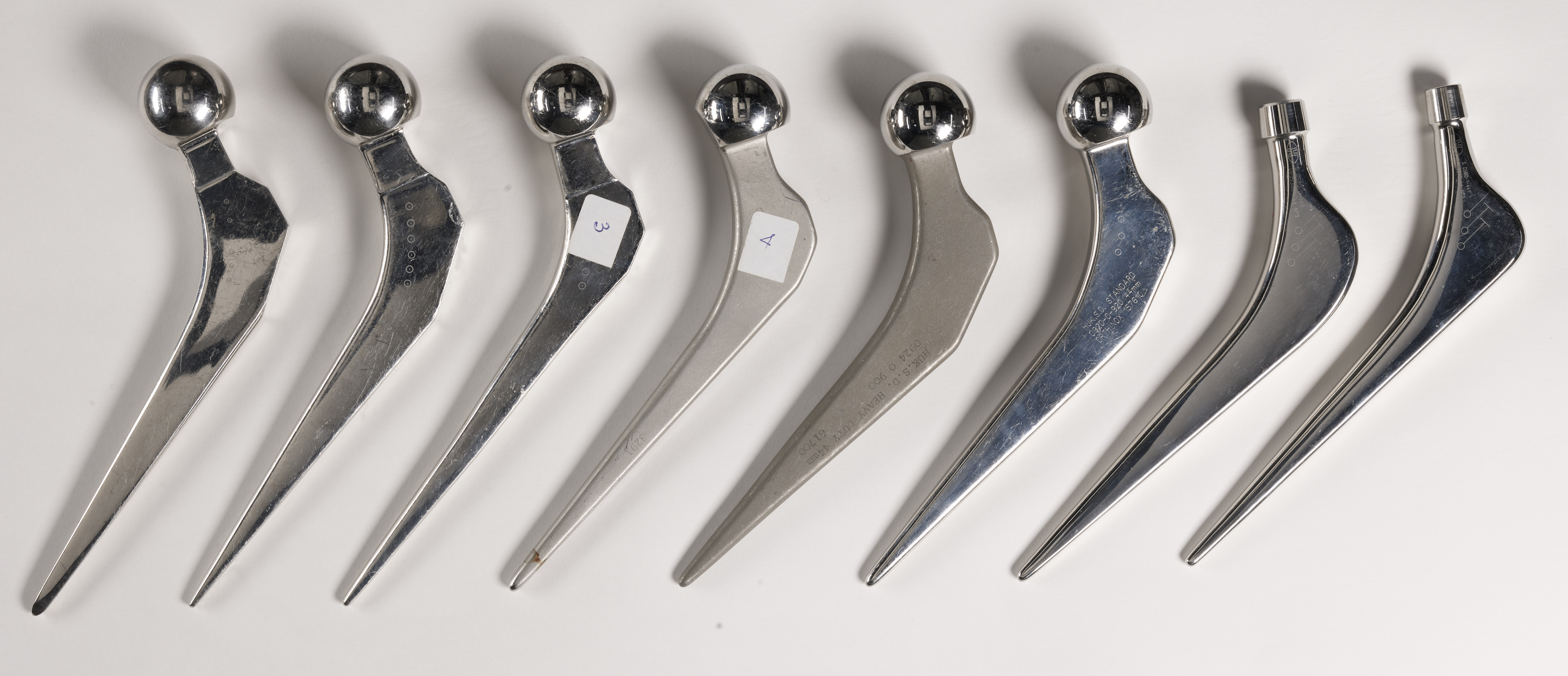
Alongside this, there is a small amount of material (largely designs and patents) relating to other creations by Lee and Ling, including total knee and total elbow replacements.
The material is available to view in our reading room, and more information on visiting the reading room can be found on our LibGuides.