Tag Archives: Manuscript

A manuscript copy of Dialogue betweene a Councellor of State and a Justice of the Peace by Sir Walter Raleigh 

Article by Kayleigh Swart, MA student of Professor Ayesha Mukherjee’s course ‘Global Voices: Shakespeare and the Early Modern World’

EUL MS 98 Manuscript copy of Raleigh’s ‘Dialogue between a Councillor of State and a Justice of the Peace, front cover

While locked away in the Tower of London for treason, Sir Walter Raleigh composed a dialogue to discuss the role parliament should play alongside the monarchy. Various copies of this work still exist in the original manuscript form, one of these copies is currently preserved in the University of Exeter’s Special Collections (EUL MS 98).  

The copy in question was created in 1615, the same year as the text was written. The document is currently labelled a ‘copy of the manuscript’, so it is not clear if this particular version was written by Raleigh himself or somebody else. Various manuscripts of this text were circulated around shortly after its creation. A few of these other copies are in the British Library as well as other archives.

The exact journey this manuscript took to end up in the collection is not entirely known but we do have some information on it. In 1953, the manuscript was sold by Maggs Bros. of London, bookdealers to Agnes Latham. It was then given to the University’s library in 1991 by Joyce Youings on Latham’s behalf. Latham was an academic and best known for her work on editing Sir Walter Raleigh’s letters, which explains her ownership of this manuscript.  

EUL MS 98 Manuscript copy of Raleigh’s Dialogue between a Councillor of State and a Justice of the Peace, page 1

The manuscript itself can only be described as delicate. Even in the above photo, it is clear that the book looks fragile and flimsy. The text is bound in soft vellum; which is another name for animal skin or membrane. Additionally, attached to the cover are two strings which would have been used to tie the manuscript. Both the cover and the strings have started to erode away and appear quite stained. However, the condition of the manuscript is expected for its age. The title on the cover has partly faded, especially over Raleigh’s name; however, it reads: A Dialogue Betweene a Councellor of State and a Justice of Peace Written by Sir Walter Raleigh. The text inside is very neatly handwritten; it could be assumed some form of line guide was used in its creation. The neatness and the binding of the text points to the possibility that this particular copy was recreated to be read by someone other than Raleigh himself. The manuscript also includes a copy of a letter addressed to the King, James I, from Raleigh. After Raleigh’s death, the text found its way into print. It was published in 1628 under the new title: The Prerogative of Parliaments in England: Proved in a Dialogue (pro & contra) betweene a Councellour of State and a Justice of Peace. Whilst the text does not significantly change between manuscript and print form, there are a few word changes or reshuffling of sentences, probably for ease of reading. 

The text itself follows a conversation between the Justice and Councillor about the current problems facing the court and debates if a parliament would be able to solve them. Whilst the form of dialogue does suggest that the text is structured as a debate, the majority of the conversation is dominated by the Justice and his pro-parliament views. Raleigh structures the work to move in a chronological way: firstly, the text begins with recounting the previous Kings and their position within the structure of power in the country. There is strong emphasis on how the Magna Carta played a role in the history of Kings. The text then moves into the contemporary world and discusses present-day problems. Additionally, the two characters debate if calling for a parliament will help or hinder existing issues. An agreement between the two characters is not reached, the councillor saying: “I conclude where I began, these parliaments are dangerous for a king,” while the Justice continues to argue for a parliament. In the final lines the Justice proclaims: “But I only seek to satisfy his majesty”. This suggests that regardless of the political position the text aligns with, it is still shaped by the idea that the King would read and respond to it. So, while Raleigh wants to make his pro-parliament views clear he also has to balance this by proving his loyalty to the crown.

Understanding Raleigh’s personal situation also helps unlock the deeper meanings embedded in the text. In 1603, Raleigh was arrested for treason and sentenced, where he was kept imprisoned in the Tower of London for almost fourteen years (Oxford DNB). During his imprisonment he began to write another text: The History of the World. This text was printed and published in 1614, however a few weeks after its publication, the work was supressed by the Archbishop Abbott on royal command (Beer 60). This was likely due to the anti-monarch views allegedly expressed in the book. The Dialogue can therefore be seen as a response to this, having been written only a few months later. In the text, the Justice notes how freedom of speech is necessary to have a successful parliament.  

EUL MS 98 Manuscript copy of Raleigh’s Dialogue between a Councillor of State and a Justice of the Peace, dialogue, pages 28-29

There is a lot to be learnt from a primary source such as this manuscript that goes beyond simply what it is or what it says. The ability to view and access these pieces of history help progress research in a range of subjects and disciplines. This particular manuscript is a remarkable clue for understanding the political contexts that confronted Raleigh, and the decisions he made in light of them. 

Works cited:   

Beer, Anna. R, Sir Walter Ralegh and his readers in the Seventeenth Century. Macmillan, 1997;   

“James VI and I, King of Scotland, England and Ireland”, Oxford Dictionary of National  Biography. Oxford UP, 2014. Accessed 8 Nov 2025, https://www.oxforddnb.com/display/10.1093/ref:odnb/9780198614128.001.0001/odnb-9780198614128-e-14592?rskey=PfoJle&result=7#odnb-9780198614128-e-14592-div1-d2270e3993 

Raleigh, Sir Walter, Dialogue between a Councillor of State and a Justice of the Peace. 1615, (EUL MS 98);

“Ralegh [Raleigh], Sir Walter”, Oxford Dictionary of National Biography. Oxford UP, 2022, Accessed 8 Nov 2025, https://www.oxforddnb.com/display/10.1093/ref:odnb/9780198614128.001.0001/odnb-9780198614128-e-23039?rskey=AhaqFA&result=4 

‘It was an amazing experience to handle books that have been used for centuries before me!’; Reflections on volunteering with Special Collections by Viktor Speredelozzi

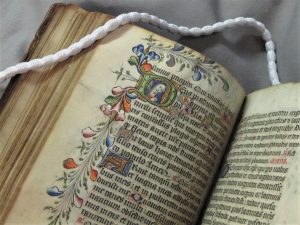
Example of mirror writing in ‘Processionale’ [EUL MS 262/1, f. 128v]

Over the past year, student Viktor Speredelozzi has been volunteering with Special Collections. Viktor used his knowledge of Latin and the medieval period to analyse medieval manuscripts in the Syon Abbey Collection and identify details – such as historiated initials and marginalia – to add to the notes section of the already existing catalogue descriptions for each manuscript. Below Viktor shares some of his impressions and reflections on the experience. We would like to take this opportunity to thank Viktor for his excellent work and wish him every success for the future.

For the 2022-2023 school year I was privileged enough for the opportunity to volunteer at the University of Exeter’s special collections. My duty was cataloguing Syon Abbey’s mediaeval manuscripts. Syon Abbey belonged to the Bridgettine Order. It was the only Bridgettine house for women in England. It was really fascinating to work with these manuscripts, piece together how they were made, and how they might have been used by the nuns.

Historiated initial showing the Virgin Mary in ‘Horae’ [EUL MS 262/2, f. 69v]

I’ve been able to look at a lot of mediaeval manuscripts during my studies at Exeter. I’ve looked at manuscripts online and in person at the Exeter Cathedral, Oxford, Stockholm, and Munich. Manuscripts commonly have red rubrication to mark paragraphs. However, Syon Abbey is unique in its use of yellow ink for rubrication. This collection is also special in its use of charming little human profiles on some of the letters. It’s always a treat to find one!

EUL MS 262/1 is one of the manuscripts I catalogued. It is a processional and contains an example of mirror writing on folio 128v. No other catalogues mentioned that was in the manuscript, so it was really cool to find something that others had missed.

EUL MS 262/2 is small, but the art is still incredibly detailed. It contains many historiated initials of the Virgin Mary and an unidentified woman (possibly Mary Magdalen?), calling attention to the fact this manuscript was made for and used by nuns. The Virgin Mary and the other woman both wear beautiful clothes with gold embroidery. The colours are still incredibly vibrant despite being made centuries ago.

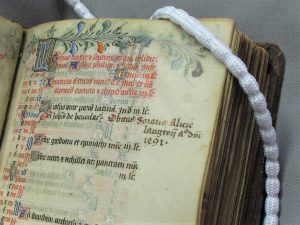
Obit of Sister Alice Langton in ‘Horae’ [EUL MS 262/2, f 3r]

The archives welcome classes of students to come see the manuscripts. During one class, Professor Catherine Rider pointed out Sister Alice’s obituary to me. On folio 3r, of EUL MS 262/2 the calendar documents Sister Alice Langton (one of the nuns) died in 1491. This is just one example of how the nuns used the manuscripts. Perhaps Sister Alice’s fellow nuns added her name in this manuscript because it was one of her favourites as a way to celebrate her life.

I really enjoyed cataloguing seven of Syon Abbey’s manuscripts this school year. It was an amazing experience to handle books that have been used for centuries before me!


Exploring Christmas at Syon Abbey

My name is Sophie and I am currently a third year student at the University of Exeter, studying for a BA joint honours degree in History and Archaeology. In September I began volunteering at the University’s Special Collections, allowing me to gain valuable work experience, as I hope to pursue a career in the heritage sector. I have spent my time as a volunteer working with the Syon Abbey archive. My main role has been cataloguing the 100 diaries of the community from the late nineteenth to the twenty-first century at item level. I have enjoyed this task as it has provided me with a detailed insight into the daily life of the community.

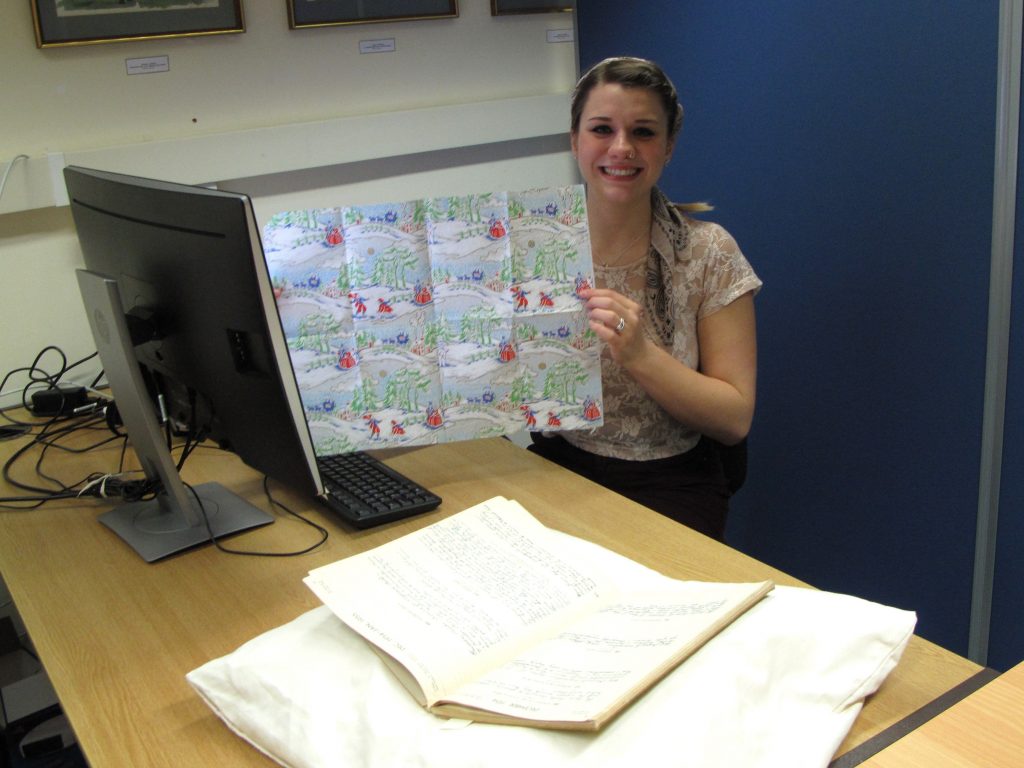
Sophie with a sheet of 1950s Christmas wrapping paper found inside one of the diaries in the Syon Abbey archive

References to Christmas in the Syon Abbey diaries

As Christmas is fast approaching, I wanted to share some details of the celebrations that are recorded in the diaries. Many of the diaries mention the sisters’ festive decoration of the Abbey. For example, in a diary kept in 1955, an entry states that ‘the sisters’ gifts were hung on a large Xmas tree gaily decorated and illuminated with colourful lights’ and that ‘all danced around the tree and sang the Jubilee song’ [EUL MS 389/ADM/5/54]. This heart-warming image of the community is particularly festive and is one of my favourite entries from the diaries.

The sisters gave gifts as a sign of their love and affection for each other, especially during the Christmas period. The diary for 1906 contains a beautiful handmade paper snowflake, given to the abbess as a gift [EUL MS 389/ADM/5/12]. The community’s enthusiasm for gift giving can also be found in the diary for 1954 which records the gifts given to the Abbey’s gardeners and farm hands. The presents included: an electric kettle, socks, tobacco, biscuits, cake, pudding, butter, tea, and a hen [EUL MS 389/ADM/5/52]. This particular diary contains many more festive references, and even an inserted piece of 1950s Christmas wrapping paper. It also contains a lovely anecdote about how the Abbess ‘thoroughly enjoyed herself’ when she carved the Christmas turkey!

Elsewhere in the Syon Abbey Collection…

In addition to the diaries that I have been working with, the Syon Abbey Collection (which includes the archive and collections of printed books and manuscripts from the Syon Abbey library) contains further material relating to the celebration of Christmas. For example, within the Medieval and Modern Manuscript Collection is a Syon manuscript entitled ‘A Discourse or Entertainment for ye sacred time of Advent’, written by the abbess in 1657, containing spiritual exercises for the nuns to undertake during Advent [EUL MS 262/add2/5].

[slideshow_deploy id=’431′]


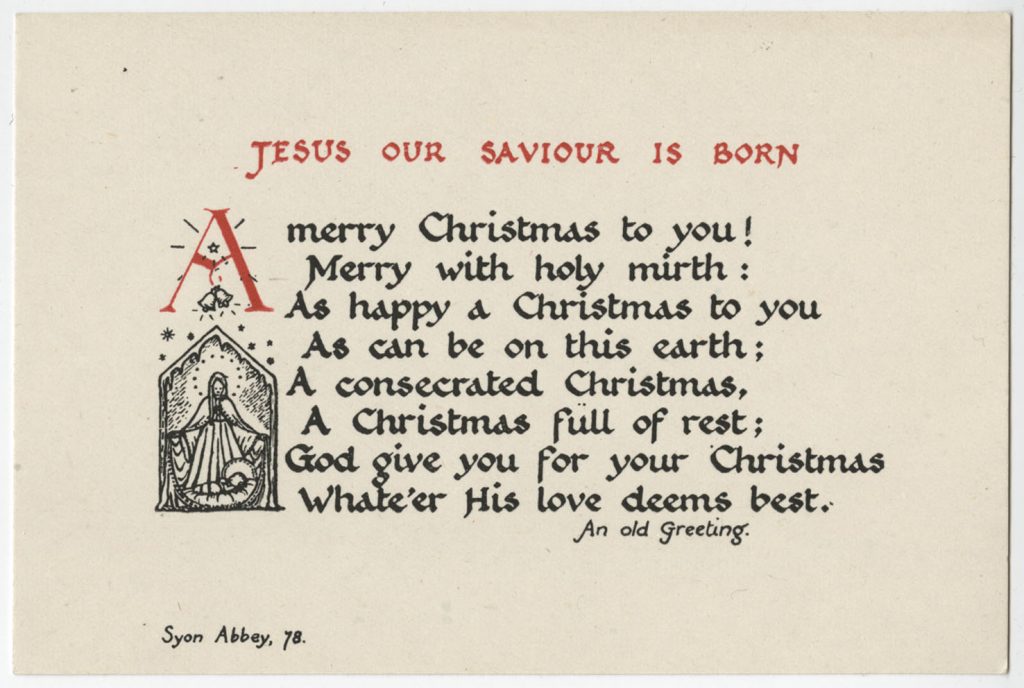
A particular favourite of mine in the Syon Abbey archive is a box containing small illuminated prayer cards with detailed calligraphy and hand drawn images relating to Christmas [EUL MS 389/CRE/3]. These beautiful pieces of art were created by Sister Mary Veronica during her religious life at Syon Abbey between 1933 and 2008.

EUL MS 389/CRE/3 – A Christmas prayer card created by Sister Mary Veronica Kempson, c 1933-2008.
Provided for research and reference only. Permission to publish, copy, or otherwise use this work must be obtained from University of Exeter Special Collections (http://as.exeter.ac.uk/heritage-collections/) and all copyright holders.

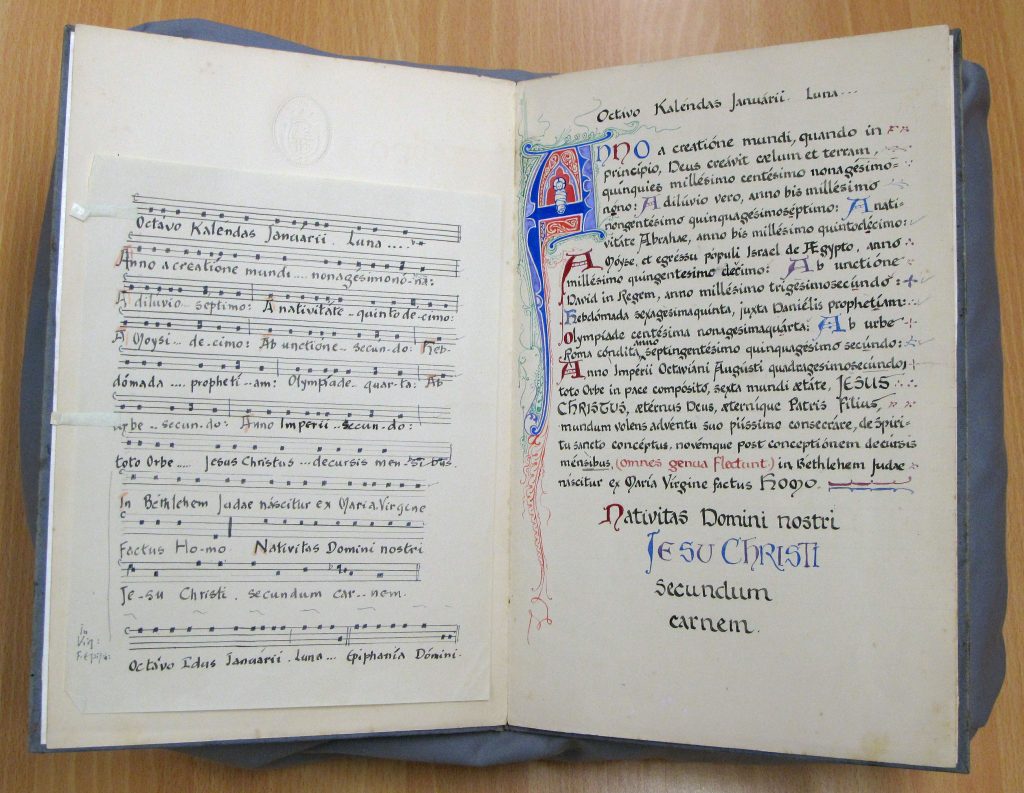
The Syon Abbey Medieval and Modern Manuscript Collection contains an illuminated transcript of the words and musical notation for ‘In Vigilia Nativitatis’ (which translates to ‘On Christmas Eve’) from the Roman Martyrology [EUL MS 262/add1/111]. This is a proclamation of the birth of Christ and would traditionally have been chanted or recited on Christmas Eve. It also contains a note on the back which details that the ‘Syon melody’ was originally taken from the Lisbon book and was handed down orally with some alterations. This ‘Christmas Martyrology’ was created in 1952 by Sister Mary Stanislas, of whom more artwork can be found in the Syon Abbey archive.

EUL MS 262/add1/111 – ‘In Vigilia Nativitatis’, created by Sister Mary Stanislas in 1952.
Provided for research and reference only. Permission to publish, copy, or otherwise use this work must be obtained from University of Exeter Special Collections (http://as.exeter.ac.uk/heritage-collections/) and all copyright holders.

To close…

The Syon Abbey Collection contains an array of fascinating material, including many insights into how the community celebrated Christmas. To find out more about the Syon Abbey Collection click here, or head to the Special Collections website to search our online archives catalogue. For those feeling festive, why not take a look at our Twitter account, where we are posting images from across the collections in our very own virtual Advent Calendar.

By Sophie Morgan, Volunteer

It’s National Poetry Day!

To celebrate Exeter Poetry Festival and National Poetry Day I have been tweeting one of my favourite Ronald Duncan poems every day this week. Why not take a look at the @UOEHeritageColl twitter feed and read a few?

Ronald Duncan published five main collections of poetry during his lifetime (Postcards to Pulcinella [1941], The Mongrel [1950], The Solitudes [1960], Unpopular Poems [1969], For the Few [1977]). In addition to these he also published a five-part epic poem ‘Man’ (1970-74) and many other individual poems. On National Poetry Day I’m moving away from the polish of published works and taking a look at some of the unique manuscripts held within the collection which offer an insight into Duncan’s life and writing process.

The poet at work

Portrayals in film and TV mean that I often imagine the writing process as a deeply organised one. The poet sits in front of his favourite typewriter, or pulls out a pocket notebook carried for such occasions, and reels off lines of beauty conveniently supplied by a voiceover. Working on the Ronald Duncan Collection has swiftly disabused me of this notion.

While the collection does contain many workbooks, and these seem to be an integral part of Duncan’s early working process, it also contains poems scribbled on paper plates, napkins, the backs of old letters and various assorted scraps of paper. To me this suggests a furious kind of franticness to the writing, an urgency that the poem must be recorded now while it is still fresh. One of the paper plates has clearly been used before being re-purposed and though it isn’t perhaps the romantic ideal of a typewriter, there’s a certain charm to the thought of Duncan wolfing down a finger sandwich or sausage roll before flipping the plate to compose a poem.

[slideshow_deploy id=’351′]


The gift of words

Like many other poets, a great number of Duncan’s poems are dedicated to family members and friends. Weddings, birthdays and christenings are all celebrated in verse and the grief of death is likewise immortalised. The idea of poetry as a gift is well established.

Duncan, however, takes this idea a step further than most. A manuscript poem dedicated to his granddaughter Karina reads ‘No Easter egg, my child, because I forgot to get one’ and provides a poem as a substitute. Though I’m not sure that I personally would have appreciated this exchange of chocolate for poetry as a child, it provides a lovely glimpse of family life. Another poem is dedicated ‘For Rose Marie, as good a craftsman in exchange for her parsley sauce’.

[slideshow_deploy id=’363′]


The art of poetry

Many of Duncan’s poems use colourful imagery to describe the natural world and a small proportion of the manuscripts in the collection have been illustrated to reflect this. The illustrations tend to be painted onto the manuscript and vary from simple bright swirls of colour to abstract representations of the poems’ subjects. The vibrant designs give a tantalising glimpse of what was in Duncan’s mind when composing the poems.

[slideshow_deploy id=’370′]


The final word

However familiar I become with the Ronald Duncan Collection, I am always aware that my interpretation of Duncan’s work is only one possibility. With this in mind I leave you with an audio clip of Ronald Duncan talking about poetry, one line of which I particularly enjoy;

“If you can’t hear me it is probably because I don’t speak loud enough, and if you don’t understand me it is because the poetry isn’t any good”

(please note that in some browsers the ‘Play’ button does not seem to appear. If you click before the timer on the left hand side of the sound bar it should start playing)

Cataloguing the Syon Abbey archive: project highlights

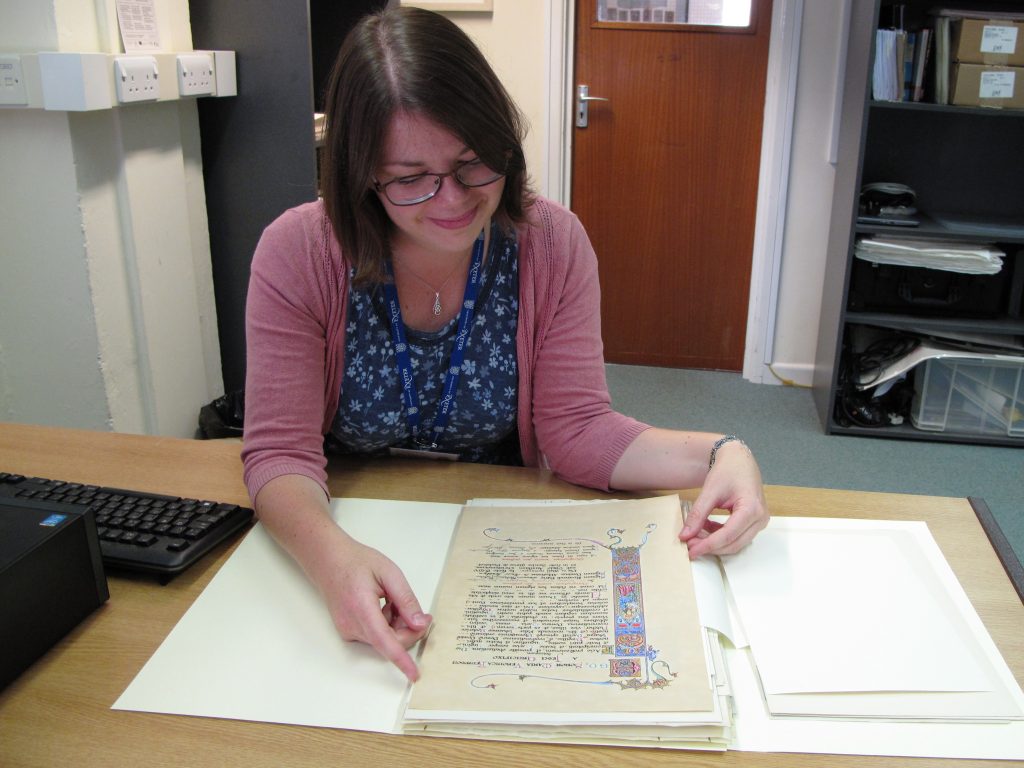
Eight months have elapsed since I began working on the Syon Abbey archive cataloguing project, and since then I have been cheerfully cataloguing my way through a multitude of fascinating records. You can find out what has already been catalogued via our online catalogue here.

As I reach the halfway point, with a further eight months still ahead of me, I take a look back at some of my highlights of the project so far…
 

Profession papers

A very special collection of records within the archive are the profession papers, which I first looked at in January 2017. The profession papers record the vows made by novices when they officially entered the order (often referred to as ‘simple’ or ‘temporary profession’) and the renewal of these vows at a later period (often referred to as ‘perpetual’ or ‘solemn profession’). The handwritten profession papers in the Syon Abbey archive date from 1607, when the community was living in Lisbon in Portugal, to the late twentieth century, when the community was settled at South Brent in Devon. It is clear that these documents were of great importance to the community, not only because we know they were kept in a safe at Syon Abbey before they were deposited at the University of Exeter, but also due to the very great care that was taken in creating them. The vows have all been lovingly transcribed and signed, and a large majority of the vows have been beautifully decorated, illuminated and illustrated. Below are four examples of vows illustrated by one of the Syon nuns, Sister Mary Stanislas, in the 1920s. I’m looking forward to cataloguing the profession papers soon as part of the ‘Community’ section of the archive.

[slideshow_deploy id=’280′]


History of Women Religious of Britain and Ireland conference

A great highlight of the project for me personally was the opportunity to attend the annual conference of the History of Women Religious of Britain and Ireland (H-WRBI). H-WRBI is a research network which encourages research of women religious, and includes academics, archivists, students and others interested in the history of women religious. This year the conference took place in June at the University College Dublin and the theme was: ‘Sources: Archival, Oral, Visual, Material, Digital’. I gained new knowledge and insight into current research from the fascinating series of papers, which has proved invaluable in understanding the context of the records I have been cataloguing. The conference also impressed me with the sheer variety of research interests and the different ways in which archives have been used and interpreted by those engaged in the study of women religious. I therefore left Dublin feeling inspired and excited to continue cataloguing the Syon Abbey archive, to ensure the archive is as usable as possible for future research and innovation.

You can visit the website of H-WRBI here.

The O’Brien Centre for Science at the University College Dublin, where the conference took place.

What the Abbey Cat Saw

Whilst creating a box list of some unlisted boxes in the archive in December 2016, I came across a pamphlet with the rather delightful title ‘What the Abbey Cat Saw’. I was pleased to have another opportunity to look at it in May this year, when I catalogued it as part of the section ‘Syon Abbey publications and printed matter’. This pamphlet was published in 1957 and written by Abbess Mary Magdalen Nevin. Written from the perspective of Punch, the Abbey cat, it describes daily life at Syon Abbey, providing insight into the structure of a Syon nun’s day and the different personalities within the community, as well recounting some humorous incidents involving the cat! You can find the pamphlet in our catalogue under the reference number: EUL MS 389/PUB/2/1.

[slideshow_deploy id=’278′]


Finding a fragment!

In August 2017, I catalogued the financial records in the archive, including a large number of account books. Within one account book I was startled to discover a fragment of parchment that appeared to be from a medieval manuscript! There was significant fire damage to the fragment; however, it was still legible and had a lovely decorated initial in blue and red ink. In addition to the Syon Abbey archive, the University of Exeter’s Special Collections also looks after Syon Abbey’s medieval and modern manuscript collection. Within this collection (reference EUL MS 262) is a folder containing fragments of manuscripts that were found c 1990 in the attic of Syon Abbey in South Brent, Devon. Upon looking through the folder, I was thrilled to find a fragment that corresponded to the newly discovered fragment in script, decoration, and fire damage. The newly discovered fragment has now been removed from the account book (a slip of acid-free paper marks the page from where it was removed) and has been placed with the other fragments in EUL MS 262/fragments. The discovery of this fragment and the reunification with its other half was a very exciting moment. It just goes to show that exciting things can be found in the most unexpected of places – especially in archives!
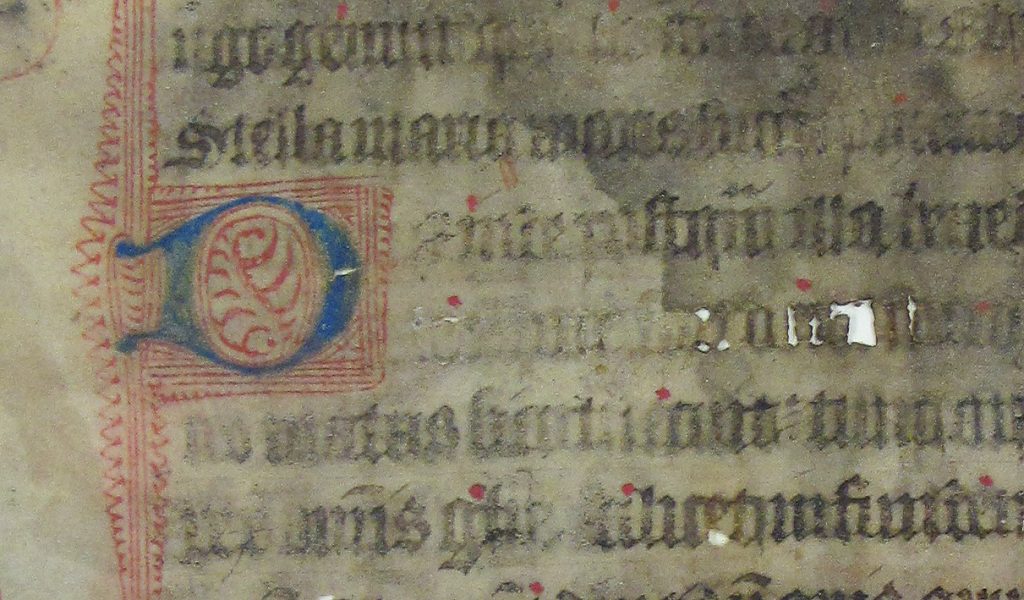
Detail from a newly-discovered manuscript fragment in EUL MS 262/fragments.

Looking ahead to the next eight months…

Over the next eight months until the project completion at the end of March 2018, I will continue cataloguing the Syon Abbey archive and making the description of the records available for you via our online archives catalogue. I also hope to carry on promoting the archive in a variety of ways, including via this blog, on Twitter, and at conferences next year. At the end of the project I hope to leave behind an archive that is much easier to search and use, as well as some new highlights to share with you!

By Annie, Project Archivist
The Writer that Rocked


In the swinging sixties the bedrooms of Britain vibrated to the sounds of Rock and Roll. Opposing the monopoly of the BBC, pirate radio stations were broadcasting popular music to the masses, with none more infamous than Radio Caroline.

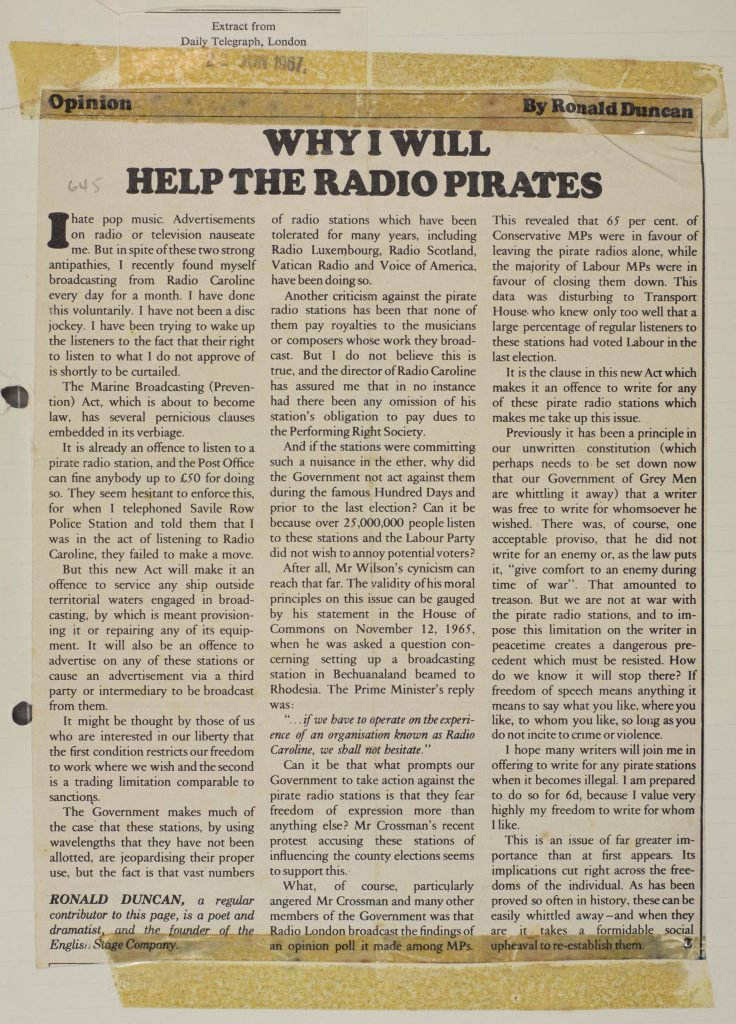
News cutting of an article by Ronald Duncan

50 years ago today, indignant at this flagrant disregard for its laws, parliament passed the 1967 Marine and Broadcasting Offences Act. This Act banned not only the act of broadcasting, but the operation of broadcasting equipment, or the knowing collaboration or assistance with the broadcasting of Pirate Radio stations. This meant that for the first time writers supplying Radio Caroline with scripts would also be risking jail.

Ronald Duncan was one of a number of writers who openly campaigned against the act on the grounds of freedom of speech. Writing a number of newspaper columns on the subject and going so far as to openly claim that he had broadcast from Radio Caroline every day for a month in protest, despite attesting that he hated pop music.

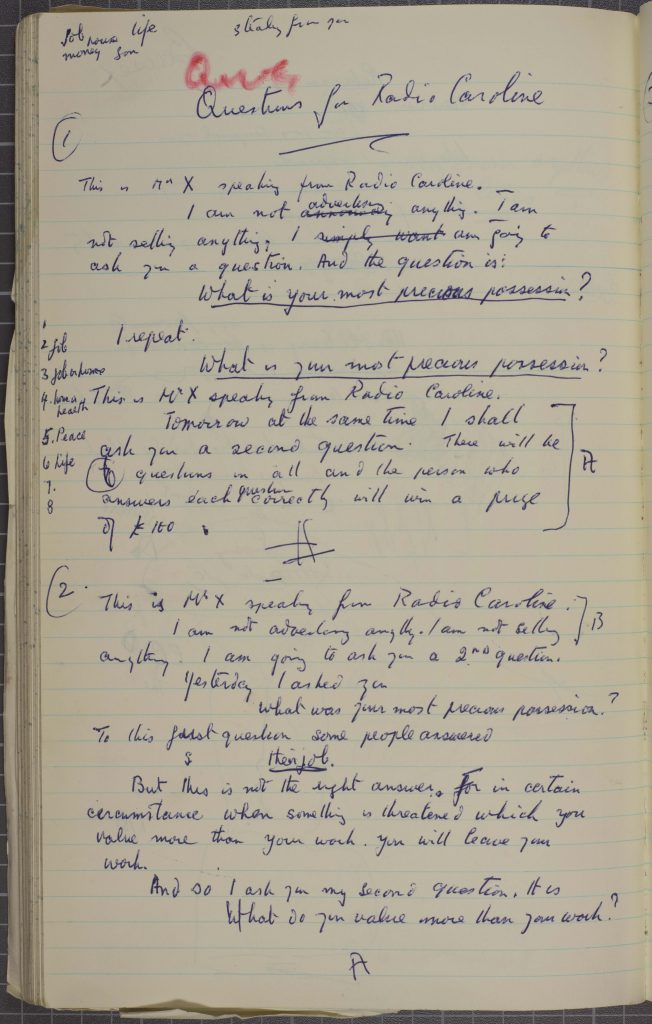
Extract from a workbook showing a handwritten script for Radio Caroline

A handwritten script and recording held within the Ronald Duncan collection suggest that Duncan likely followed through with his claim to write for Pirate Radio, though as these were written under the generic pseudonym ‘Mr X’ it would take a great deal of research into the depths of Radio Caroline’s archives to see if he did indeed ever spend a week aboard the ship. Either way, his campaigning on behalf of the pirate stations’ freedom of speech earns him a small place in the
annals of radio history.

Listen to a short extract of a recording of Ronald Duncan’s script for Radio Caroline below.