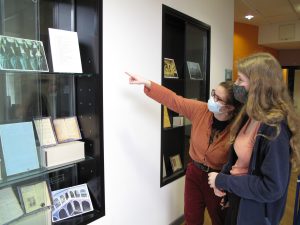
Tag Archives: Library

“My time here at Special Collections was a very memorable one”: Reflections on a week of work experience in Special Collections

We were delighted to be joined last week by Year 10 student Sami for a week of work experience in Special Collections. Below Sami shares some of his impressions and reflections on the experience. We would like to take this opportunity to thank Sami for his excellent work and wish him every success for the future.

The Hypatia Collection of books and journals by and about women, which Sami helped to stocktake

On Monday, the first day of my Year 10 Work Experience placement here in the University of Exeter’s Special Collections, I was greeted by my supervisor for the week and one of the archivists, Annie. She took me on a brief tour of the old library before showing me the office, where I would be doing the main activities for the week. Annie then introduced me to the very friendly Special Collections staff where I immediately knew that this would be a very welcoming and calm environment. I was then given a timetable and Annie explained the different activities that I would be doing throughout the week. After getting know what I would be doing during my time here, Annie took me on a basic tour of the campus and showed me where the cafes and other stores are located as well as areas where you can sit down and have lunch. I then had a fifteen minute break before Annie explained to me what archives and collections actually are, and how to handle them in a way so that they are not damaged. This was the first hands-on training I had received and I found it to be very interesting and informative. After my lunch break, I had a chat with Annie about her role here at Special Collections and what she does and I had a chance to ask her some questions about it. After having a chat with Annie, she introduced me to the main tasks that I would be working on, stocktaking the Hypatia Collection and repackaging architectural plans from the University Archive. I did these tasks until 3:30pm before having a chat with Caroline, the Head of Heritage Collections about her role to finish off the day. 

On Tuesday, I started off the day by having a chat with Hollie, an Archivist, about her role and how/why she decided to become an Archivist which was quite nice to talk about. This was then followed by some repackaging and stocktaking until 11:30pm. For the next hour until my lunch break, I was given a tour of the Forum Library and the forum which I found to be very interesting and one of my favourite parts of the week as the Library and the Forum have some amazing features which make them brilliant for students who want a nice place to study at and fascinated me. After lunch break, I had a chat with Sarah-Jayne, one of the Special Collections Team Leaders, and she gave me a fun task of reshelving and retrieving items in the strongroom which was slightly challenging! I then did some stocktaking and repackaging until the end of the day. 

University Archive, EUL UA/P/3c: Presentation of honorary degree to Viv Richards

On Wednesday, from 10am until around 12pm, I prepared a social media post for “Throwback Thursday”. The post that I created used a photograph from the University Archive of Antiguan Cricketer Viv Richards receiving his honorary degree from the University of Exeter in 1986. I found this activity very enjoyable as I am familiar with posting on social media. After creating the social media post, I had a short break before my lunch break. Once my lunch break had finished, I did some repackaging and stocktaking for around thirty minutes before the Digital Humanities Lab tour which was one of my highlights of the week as I got to have a small glow-in-the-dark ghost 3D printed! It was amazing to see the all of the cool, advanced technology they have in the Digital Humanities Lab which made it enjoyable. As soon as the tour had finished, my working day had to come to an end. 

On Thursday, for the first twenty minutes, I posted the Throwback Thursday on the Library’s Instagram page and it was really nice to see how well it was received and liked by multiple people. After that, I had a nice chat with Jamie, the archivist for the Middle East Collections, about his role and the DAME (Digital Archive of the Middle East) project which he works on. This was followed by a marketing meeting between the Library and Special Collections which I found to be quite informative as it was a first time experience for me and gave me an insight on how staff prepare the university for the coming year and how to make it the best it can be for new and returning students. After my lunch break, I had a tour of the Bill Douglas Cinema Museum with Chris, a Museum Assistant, which I found extremely interesting as I love history and film and the tour combined both of those together. After my tour of the Bill Douglas Cinema Museum, I had a chat with Angela, one of the Special Collections Team Leaders, about her role and how she keeps the temperature and humidity in the strongrooms at a level where the archives are least harmed before finishing off the day. 

Collage of images from the University of Exeter Special Collections

Finally, on Friday, I did some stocktaking and repackaging before having a chat with Aino, one of the Special Collections Assistants, about how she frequently needs to check that the strongrooms are free of insects which may damage the archives and the insect traps which are put in place. It was then lunch break, and after lunch, Jamie showed me how he digitises books and puts them onto the DAME website to make them easily accessible for people all over the world and in particular, students. This was really nice as he even let me help him with the process! 

Overall, my time here at Special Collections was a very memorable one and I would like to recommend doing your work experience here as it is a very fun, interesting and enjoyable. 

Remembering Leslie John Lloyd (1907-1975), University Librarian

The 01 June 2025 marked the 50th anniversary of the death of Leslie John Lloyd, former University Librarian from 1946 to 1972.

John Lloyd joined the University College of the South West (a predecessor institution of the University of Exeter) in 1930 as an Assistant Lecturer in English, progressing to a Lecturer in English in 1937. During the Second World War, Lloyd attained the rank of Captain, and acted as the Commanding Office of the S.T.O. (Senior Training Corps), a military unit mainly formed of academic staff and male students, which later became part of the Home Guard and was involved in the defence of Exeter.

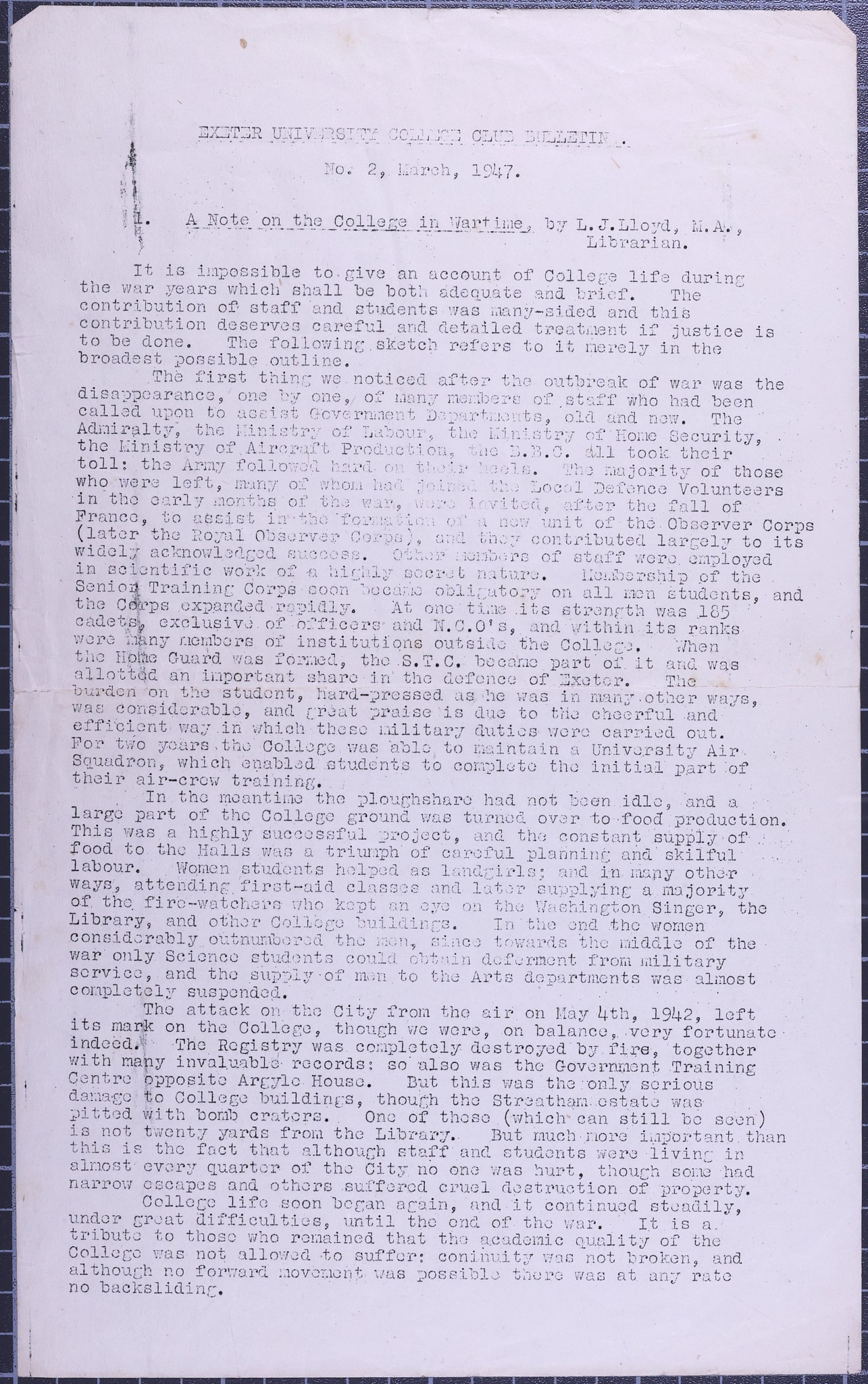
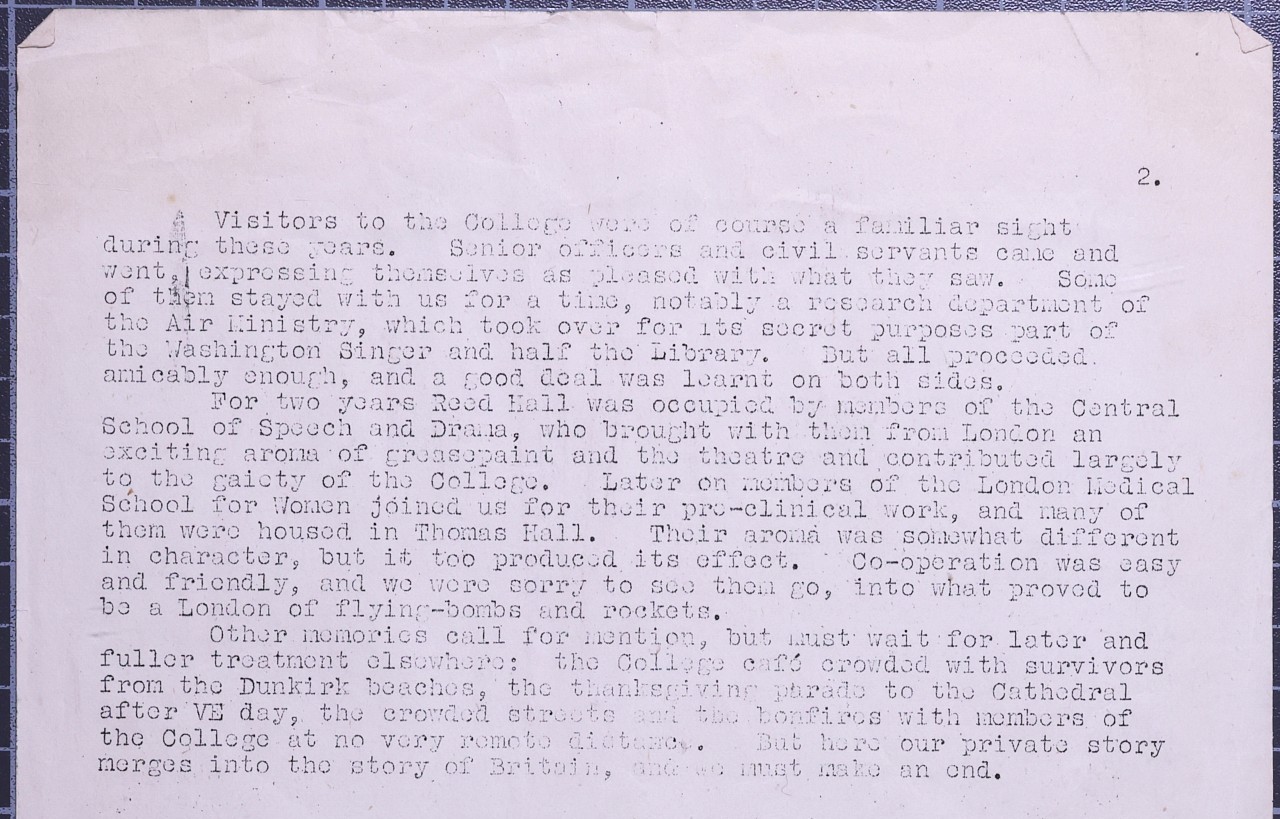
While searching in the University Archive for traces of John Lloyd, we came across a typescript document entitled ‘A Note on the College in Wartime, by L. J. Lloyd, MA, Librarian’, written for publication in the Exeter University College Club Bulletin in March 1947. It offers fascinating insight into the experiences of university staff and students during the Second World War, mentioning not only the students and staff involved in military service, but also secret scientific work, food production at the college, the significant contributions of women, the Exeter Blitz, and students that were evacuated from London. At the end of this blog post, we have included a digitised copy of Lloyd’s article (the original is very faded), which so vividly and sensitively captures this difficult time in the university’s history.
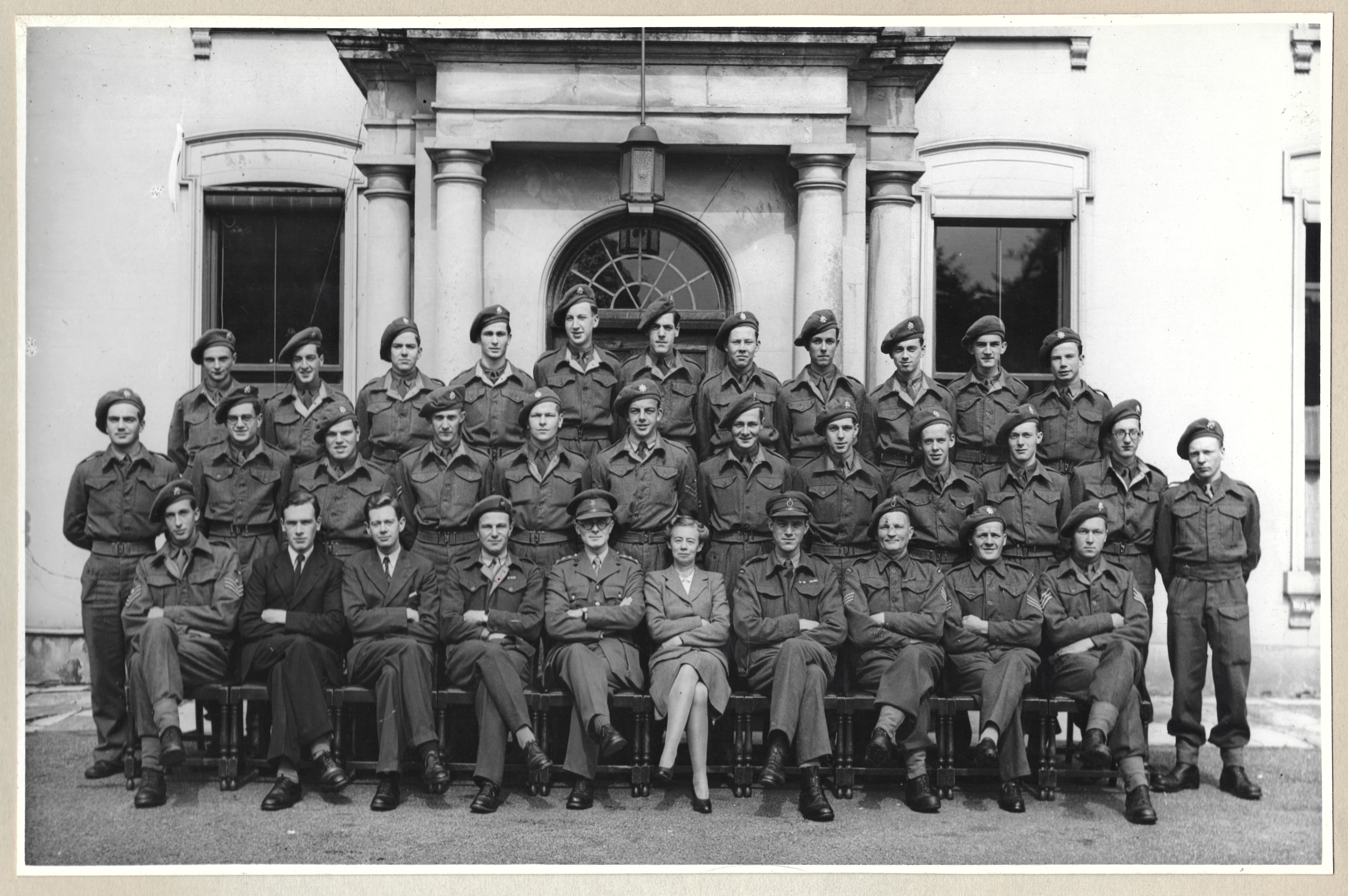
EUL UA/DRO/113: Photograph of the S.T.C. during the Second World War. John Lloyd is seated in the front row, fifth from left. (Copyright: Henry Wykes, Portrait Painter and Photographer)

In 1946, John Lloyd became the University Librarian of the University College of the South West, a position which he held until his retirement in 1972. During this period, he witnessed great changes at the university, including the founding of the University of Exeter through the Royal Charter granted by Queen Elizabeth II in 1955. During his tenure, John Lloyd also saw the student population rise from 646 students in 1946 to 3,541 students in 1972 – and, for similar years, the number of books in the University Library rise from around 70,000 to 280,000! (Source: University Calendars)
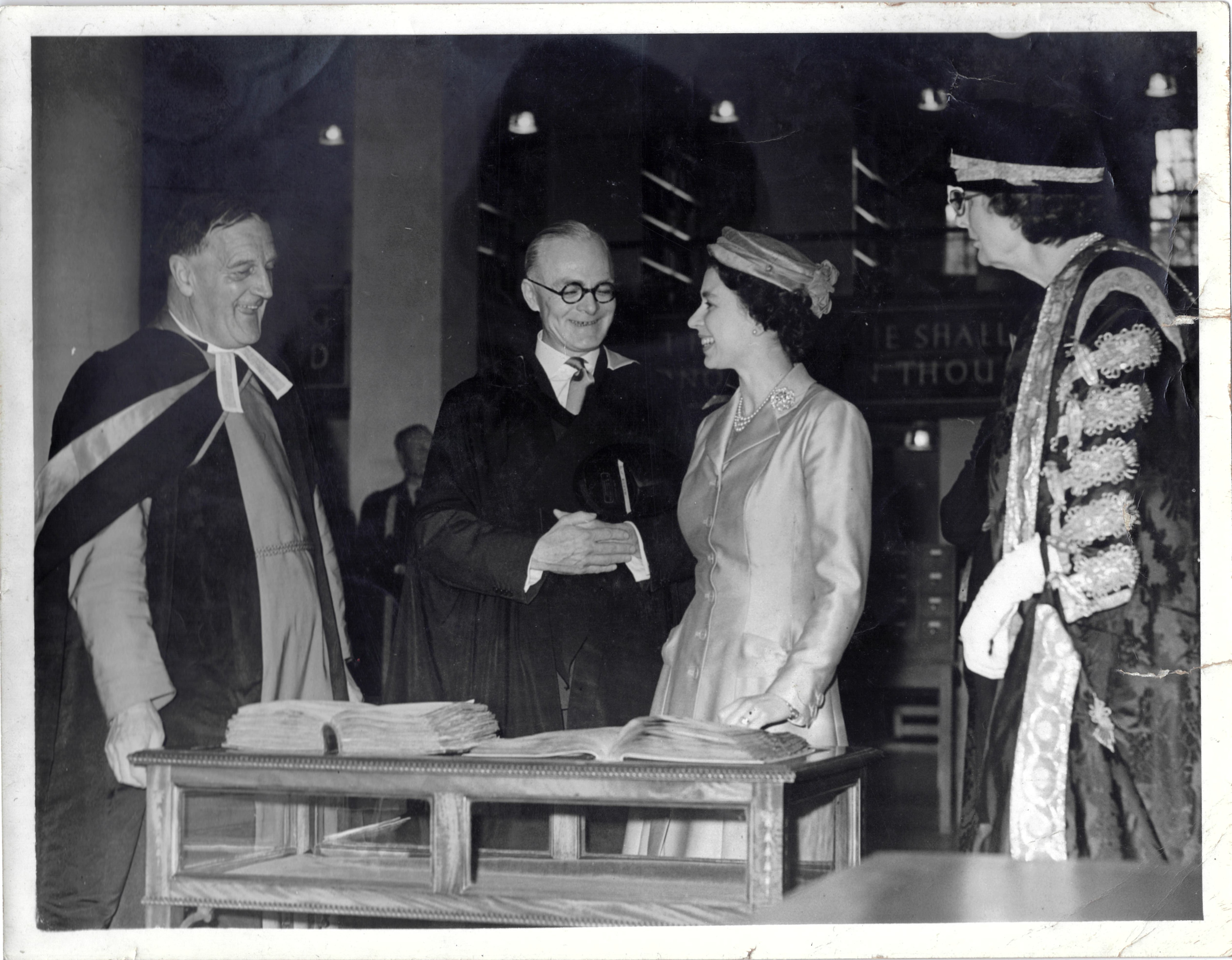
EUL MS 310 add. 1: Photograph of John Lloyd (second from left) during the visit of Queen Elizabeth II in May 1956. (Copyright: Western Morning News)

According to John Lloyd, a University Library:

“…should aim to be the cultural focus and centre of the whole University, a place in which every reasonable need of the student can be met, whether this be scientific, literary, artistic or – I was going to say practical – since a treatise on spin bowling or the chess tactics of Capablanca would I suppose take their comprehensive provision for the good life…My point is that students should be given the widest possible opportunities of developing whatever interests or talents they may have; and the library can, and should, go a very long way towards their provision. These are vital formative years; and it is our business to see to it that a stimulus is present at every turn.”

(Source: An address given by John Lloyd in 1956, published in ‘The University of Exeter: A History’ (1982), by B. W. Clapp, p. 169)
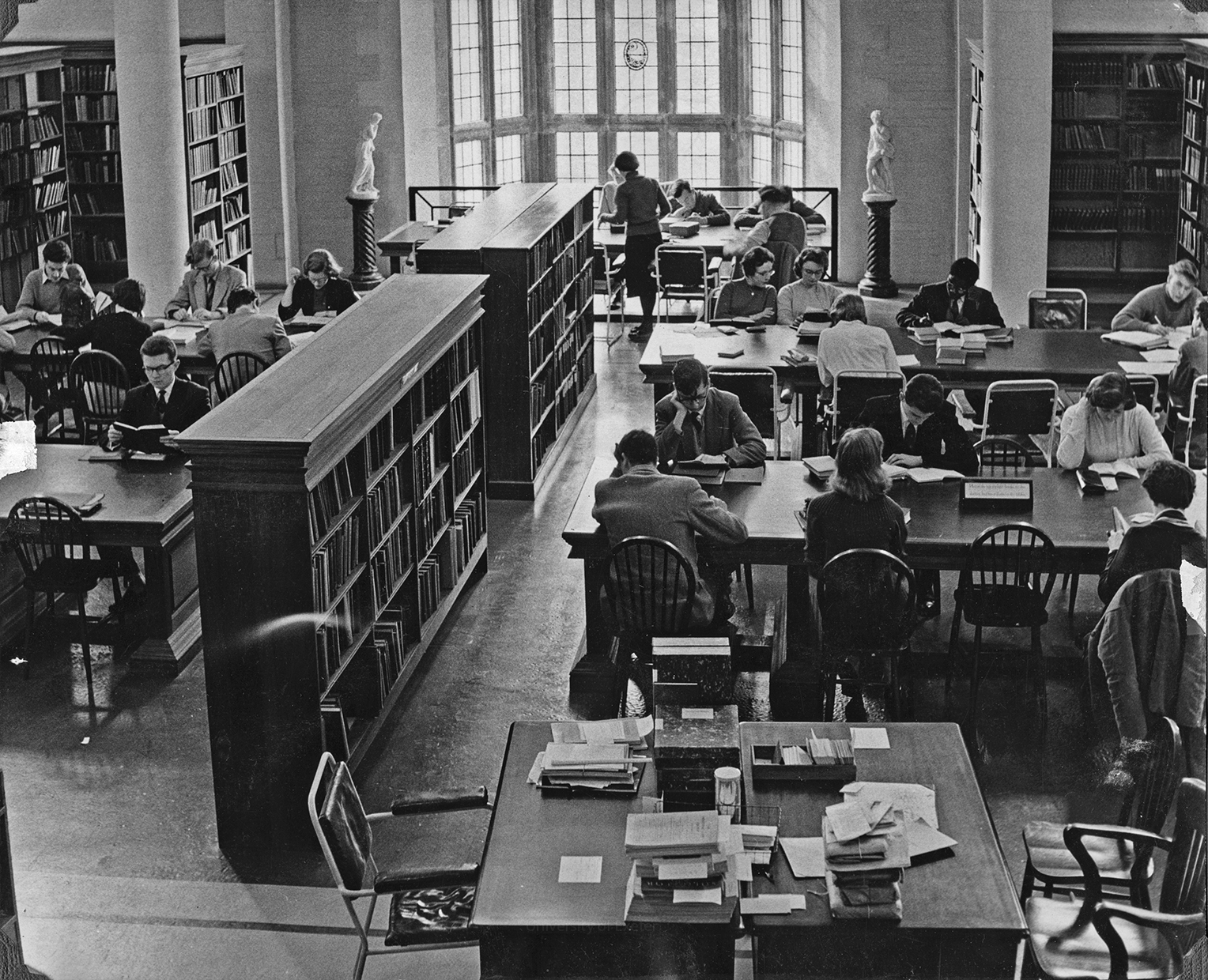
EUL UA/P/1b/5: Interior of the Roborough Library in 1958

John Lloyd was responsible for the Library during a period in which it acquired a great many of the rare books now housed in Special Collections. He was also influential in the acquisition of the first groups of literary papers, from R.D. Blackmore and Henry Williamson, which cemented the University Library’s commitment to collecting the archives of writers associated with the South West of England.

In addition to his role at the University of Exeter, Lloyd was also the Cathedral Librarian at Exeter Cathedral (see a blog post by Emma Laws, Exeter Cathedral Librarian, for more information); a published author; an avid book collector; an active supporter of the Civic Society and of the Friends of the Cathedral; a violinist who played the lead in the orchestra of the Exeter Choral and Orchestral Society for many years; and the founder of the Erratics Cricket Club, the University of Exeter staff cricket team.

John Lloyd died on 01 June 1975, at the age of 68. In an address given at the memorial service held in the Mary Harris Memorial Chapel at the University, his friend Frank Barlow (Professor of History at the University of Exeter) described him as ‘one of the nicest men I have ever known. He was kind, extremely generous, most hospitable, and with a great talent for friendship’ (Source: Exeter University 796.358 FISThe Erratics: Fifty Not Out).

Lloyd’s generosity was shown even after death in the bequeathing of his collection of 130 rare books to the University Library under the auspices of his wife, Vera Lloyd (née Woodbridge). Today, this collection forms one of the rare book collections looked after in the University Library’s Special Collections. The Lloyd Collection comprises a variety of rare books, mainly dating between the 18th and 19th century, of which many are illustrated or have fine bindings. The collection includes a first issue of Bram Stoker’s ‘Dracula’ (Westminster: Constable, 1897), with its lurid yellow cover. All the rare books in the Lloyd Collection are listed under the call number ‘Lloyd’ here on the Library Catalogue.
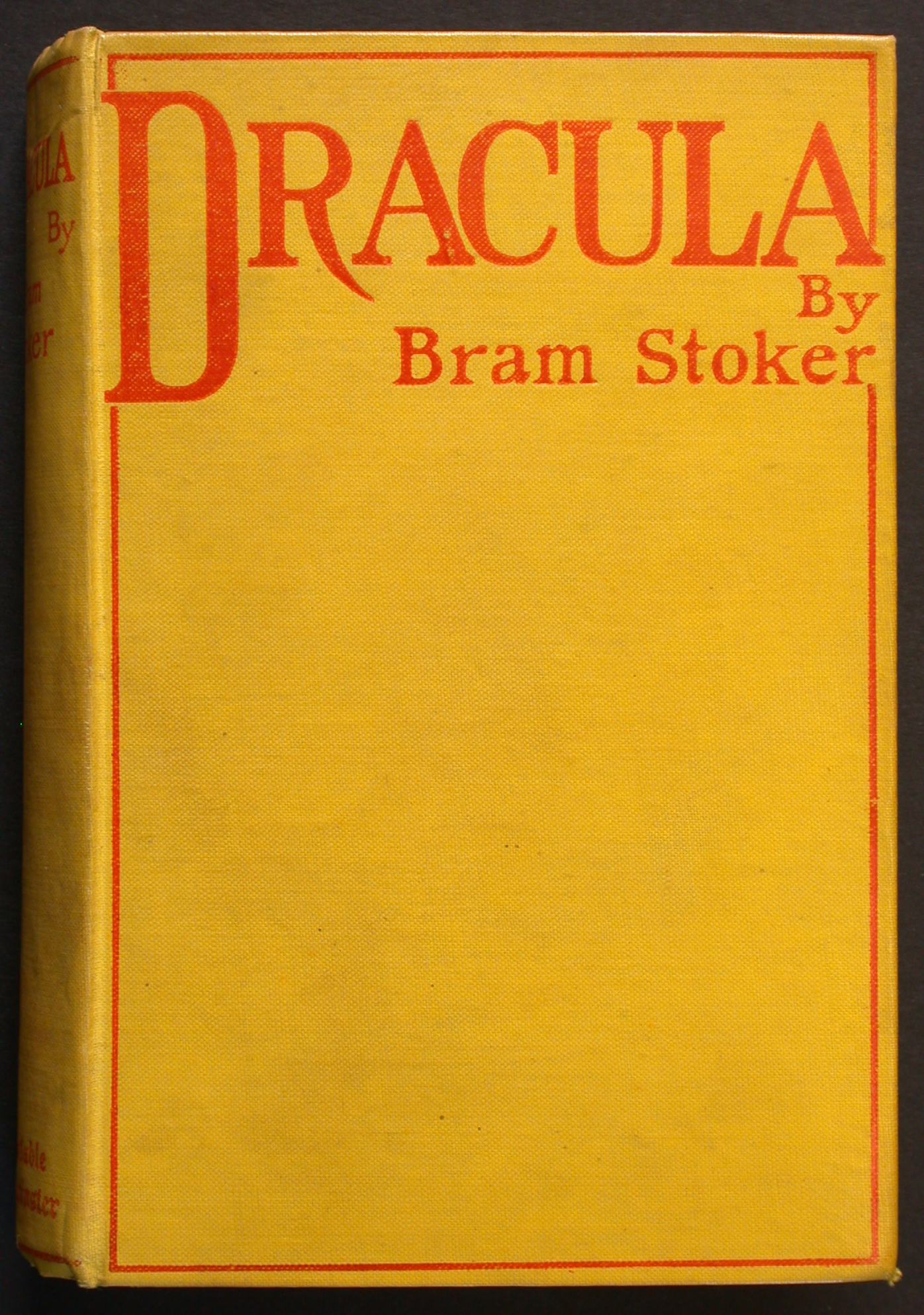
Lloyd 828.8/STO-4: ‘Dracula by Bram Stoker

As with all of our collections, items from the Lloyd Collection and the University Archive are available for everyone to access in our Reading Room for research, interest or enjoyment. In this spirit, we hope we are continuing with John Lloyd’s ethos of enabling students, staff and visitors to the university to access the ‘widest possible opportunities of developing whatever interests or talents they may have’.


With grateful thanks to John Marshall, nephew of John Lloyd, for bringing the 50th anniversary of the death of John Lloyd to our attention, and for kindly providing some of the information used in this blog post.


‘A Note on the College in Wartime, by L. J. Lloyd, MA, Librarian’, written for publication in the Exeter University College Club Bulletin in March 1947
Behind the Scenes at Special Collections: A Week of Work Experience

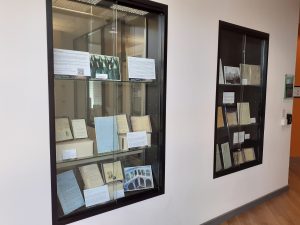
The new display outside the Ronald Duncan Reading Room

We were delighted to recently welcome Rosie and Scarlett, two Year 12 students from Colyton Grammar School, for a week of work experience at Special Collections. Their task for the week was to create a new display focusing on the Syon Abbey Collection, which involved handling, researching, digitising and curating a selection of rare books and archival items.

The new display is open to everyone and can be found by entering the Old Library on Streatham Campus via the main entrance, turning right at the barriers and walking down the corridor towards Seminar Room A/B. The display is located on the right outside the Ronald Duncan Reading Room.

Scarlett and Rosie have kindly sent us their thoughts and impressions of their week of work experience in Special Collections, which you can read below. We would like to take this opportunity to thank Rosie and Scarlett for their excellent work and wish them every success for the future.

Scarlett’s impressions:

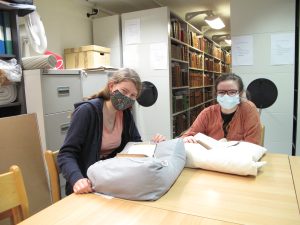
Rosie and Scarlett handling books from the Syon Abbey Library

When I first started work experience at Special Collections, the only time I had seen books older than two hundred years was behind a glass case but by the end of my time I had handled plenty of rare, old books safely.

During my time there I had the opportunity to research extensively and explore their Syon Abbey collection and helped develop a display on it with the other work experience member.

To start with, we began to research Syon Abbey and looked into the vast history of the abbey, its community and the nuns there. As one of the oldest English Catholic communities to continue meeting throughout the Reformation there was much to cover and explore and our research was well aided by the vast collection of such treasured books that brought to life the history of Syon Abbey in our hands.

We also learned how to handle old and delicate books and spent time making sure we would treat them correctly whilst researching. Well accompanied by our book snakes and cushions – tools that help support particularly old books – we began our research.

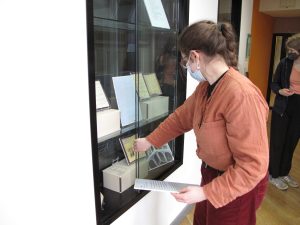
Installing the new display

To find a starting point, we searched for inscriptions made by the nuns in their books and made note of them. At times handwriting was indecipherable but that difficulty was rewarded with the satisfaction of seeing one nun’s distinctive handwriting or name in multiple books. Their inscriptions ranged from jokes regarding piety, descriptions of nieces getting married or just their own names.

Next, we decided on four nuns to focus on, each of us researching two in great detail for the display. This gave us a wide scope of the abbey as the nuns were from different times and fulfilled different roles for their community. We both created biographies for our nuns which gave a broad overview of what their day to day life would have been like and what they did in the abbey.

Finally, we began putting the last touches together for the display which entailed photographing documents, mounting them on boards and arranging our text and images to create an engaging display.

Rosie’s impressions:

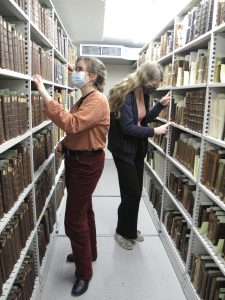
Reshelving books!

I spent the last week with the Department of Special Collections at Exeter University for my Year Twelve work experience, and it was amazing. I was a bit nervous when on the first day, and took a lot of comfort in the fact that one of my friends from school, Scarlett, had the same work experience, but I really shouldn’t have worried. My supervisor for the week was Annie, who was absolutely lovely and so helpful, and while I didn’t speak to the other members of the department as much as they were working on their own projects, I still felt so much like part of the team.

Special Collections works with significant historical documents and manuscripts, especially from people who were connected to the South West. For example, there is an extensive William Golding archive – author of Lord of the Flies – , which contains artefacts such as correspondences between Golding and publishers and his friends, as well as the original manuscripts of some of his works, like the Lord of the Flies manuscript.

Scarlett and I, however, were working on the Syon Abbey collection, which involves a great majority of the extensive library of the nuns of Syon Abbey. They had a fascinating history originating in England, traveling around Europe due to external pressures, significantly to Lisbon, and finally returning to England, mainly based in Chudleigh and South Brent, which is where the link to Devon comes in. During our stay, we got to look at and handle books from as far back as the seventeenth century, which was an amazing opportunity. I almost couldn’t believe it! Before we were allowed to handle these precious artefacts, we were trained in the correct way to take the books out of shelves and read them without damaging the spines or the pages. There were a load of things that I had never considered, like what we called book snakes, which are soft weights to hold the pages flat while you read, while not putting oils into the pages like holding it with your fingers would.

Planning the new display

Our task for the week was to create a display about Syon Abbey, so we took quite a few old books and manuscripts out of the library to help us. We went through each book to see which nun had owned each book, and if they had written anything particularly interesting. The majority of them only had a name at the most, but the few that had more were intriguing and occasionally hilarious. My personal favourites of each were, respectively, an account of Napoleon invading Portugal and the subsequent consequences, and one joke about not being able to trick God, but by keeping a religious book she could trick her peers. We narrowed down our options of nuns to research, and chose two nuns each to focus on for the display. I chose Sister Constancia Sorrell – who recorded Napoleon invading – and Lay Sister Mary Gomes – who joked about not being able to trick God.  I think that one of the best parts of the week was constructing the actual display, and seeing the outcome of all our hard work, which I, at least, am very proud of. It felt a bit like being an interior designer, as we wanted the display to be eye-catching and visually appealing while still conveying the interesting things that we learnt in the week, and hopefully getting other people interested in the subject and the monastery. We had to establish a title for the display, and while I’m disappointed that my various nun puns were vetoed, – I was particularly fond of “Nun so Faithful”- I thought that “Her Book” was equally effective, with the reference to how they wrote their names in their books, for example, “Mary Gomes her Book” and also with the extra reference to the “Book” as the Bible.

In the end, the week was so fun and interesting, while also feeling productive and like we achieved something, and I have definitely gained a new respect both for the nuns of Syon Abbey, and for the archivists at Special Collections who work with so many precious artefacts and make them accessible to people like you and me.

I would like to thank everyone who works at Special Collections for being so helpful and welcoming, and especially Annie who made our week there so memorable.

I hope that this has encouraged anyone reading this to think about visiting or researching either Special Collections or the amazing history of the nuns of Syon Abbey.

You can find out more about the Syon Abbey Collection in our blog posts and online guide